
With over 280km of off-street trails and on-street bike routes, think of the places you can go! Discover the freedom and independence that cycling offers people of all ages. Check out the Cycling map to view the Cambridge Bikeway Network.
Transportation
Explore transportation options and find information on speed management programs that the City offers to help create safer neighbourhoods.
Types of Transportation
Communauto provides carsharing services in Cambridge.
Vehicles can be reserved at a low cost, from one hour up to a full day or longer.
Three vehicles are available in Cambridge:
- One car at Beverly Street Parking Lot (15 Beverly Street)
- Two cars at Water Street Parking Lot South (9 Water St South)
For information on rates, membership and FAQ's visit ontario.communauto.com
Grand River Transit (GRT) provides local bus and light rail transit services in the Region of Waterloo.
The main bus station in Cambridge is located at 35 Ainslie Street South in Downtown Cambridge.
GO Transit offers bus service to the Greater Toronto Area. Go buses stop in the Cambridge SmartCentre on Hespeler Road near Highway 401. Go Bus route 25 provides service from Kitchener to Mississauga.
Speed Management
Through the Speed Management Program residents can request temporary speed awareness features or assessments for physical traffic calming tools.
For information on locations where the Speed Management has been implemented, see the Speed Management Dashboard.
The City uses a Traffic Calming Policy to evaluate concerns and prioritize locations where improvements can have the greatest benefit. To request a copy of the policy, please email transportation@cambridge.ca
Traffic Calming
Traffic calming measures are used to address speeding concerns and improve safety for all road users.
Common traffic calming measures include on-street parking, speed cushions, curb extensions, raised intersections, and raised crosswalks. Solutions such as traffic signals, all-way stops, or lower speed limits are not considered traffic calming tools.
Seasonal On-Road Traffic Calming Signs
A type of “soft calming”, Seasonal Traffic Calming signs are a tool that can be used to control speeds, increase awareness of school and trail crossings or delineate lanes. As the name suggests the signs are seasonal and are only used between May and October. Outside of this time period the signs are removed as they impede winter maintenance operations and are likely to be damaged.
Examples include:

Speed reduction - Used in a series or in conjunction with physical traffic calming the signs are used to narrow the lane widths, altering driver behavior. The narrowed lanes make most drivers less comfortable speeding without negatively impacting emergency services and transit.

Pedestrian crossings - The seasonal traffic calming signs are also used to increase visibility and awareness of school or trail crossings. A sign placed near the centre of the crossing is more visible to the driver and increases awareness of the crossing.

Lane separation - The flexible bollards are commonly used to delineate bike lanes, multi-use trails or along the center line of the road to delineate two-way traffic and prohibit passing.
Drivers, including those on bicycles, e-bikes, and e-scooters, must stop and yield at:
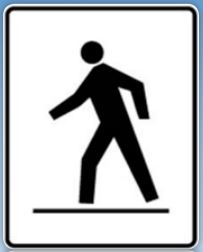
Pedestrian Crossovers:
Rectangular black and white pedestrian signs mean that pedestrians have the right of way, drivers are legally required to stop for the entire duration of the crossing
School Crossings with Guard:
Crossing guards control the whole crosswalk, drivers may not cross the crosswalk when the crossing guard has a stop sign on display even if their lane is open. Pedestrians do not have the right-of-way unless a crossing guard is not present and displaying a stop sign.
Drivers and cyclists who do not yield may be fined $150 to $500 and face three demerit points.

Radar Speed Boards display real time speeds of oncoming vehicles. The Radar Speed Board Program is an educational tool intended to promote safe and responsible driving throughout our neighbourhoods. The program educates motorists on the speeds at which they are driving, as well as educating residents about the real speed of vehicles traveling through their neighbourhood.
The program is based on the principal that many motorists are somewhat unaware that they are travelling at an excessive rate of speed, since most motorists generally drive at a speed deemed comfortable, depending on road geometry and roadside development. The operating speed electronically displayed on the Board is a strong visual reminder to the motorist to comply with the posted speed limit.
The Radar Speed Boards have been well-received as a community education tool to raise awareness of motorist travel speed through neighbourhoods.
The "Where’s Tommy & Friends?" program aims to make drivers more aware of their surroundings, especially in school zones, at corners and pedestrian areas.

How does it work?
Residents can send an online request for Tommy or one of his friends to visit their street for a couple weeks. If multiple requests come in, a waiting list will be formed.
Crossing Guards
School crossing guards are an essential part of our school community. They play an important role keeping our children safe as they travel to and from school. Their job may seem simple, but it requires a great deal of patience, attentiveness, and dedication. They work in all kinds of weather conditions, temporarily stopping traffic, and guiding children across the street.
The City of Cambridge currently has 50 active locations supervised by Adult School Crossing Guards.
When drivers see a crossing guard with a sign lifted:
- Slow down and come to a complete stop
- Wait patiently until all pedestrians and the crossing guard are completely off the road before proceeding
Below are a few more simple actions to keep our community safe, especially in school areas and zones:
- Be alert and aware of children crossing the street, even if the crossing guard is not present
- Be particularly cautious when driving near school buses, as children may be getting on or off the bus
- Look for pedestrians, especially when turning left or right
- Always make eye contact and confirm with pedestrians that they know you’re yielding the right of way or turning
- Do not use handheld electronic devices (texting or talking) or other distractions such as eating and drinking when driving
- Be extra aware and follow slower speed limits in school zones and in neighborhoods where children are present and sometimes unpredictable
- Be patient and allow extra time when traveling through school zones during peak hours
- Adjust your driving according to weather and traffic conditions
We're currently hiring crossing guards for the school year! You can work at one of our various locations around the City. Our crossing guards work two to three hours a day. If you enjoy working outside and with the public, apply today!
Construction and road safety
Help keep road workers safe. Slow down, follow posted signs, and stay alert when driving through construction zones. Learn more about road signage in Ontario.
