Transportation

Quick links:

  1. Speed Management
  2. Traffic Calming
  3. Types of Transportation
  4. Cycling Safety Tips

Need help getting to or around the city of Cambridge? The City has multiple transportation options to choose from!

Walking and cycling to work, school or just for fun is a great form of physical activity. Cambridge has a strong network of off-road trails and on-road cycling routes on both municipal and regional roads.

Speed Management

The City has a series of tools to create more liveable neighbourhoods by mitigating the impacts of traffic and speeding.

Through the Speed Management Program residents can request temporary speed awareness features, assessments for physical traffic calming, or launch their own neighbourhood improvement project.

For information on locations where the Speed Management has been implemented, see the Speed Management Dashboard.

If you would like to inquire about Speed Management email transportation@cambridge.ca.

We're committed to creating safer streets for all residents. The Neighbourhood Area Speed Limit Project is a key initiative in achieving this goal, reducing speeds, and improving safety for drivers, cyclists, and pedestrians.

Starting in spring 2024, we are working to lower speeds on select City streets.

Why are Speed Limits Changing?

Speeding is a major contributing factor in traffic collisions. The Neighbourhood Area Speed Limit Project is based on the following facts:

  • Speed is a factor in roughly one-third of all fatal collisions [Ontario Traffic Council].
  • Lower speeds lead to less severe injuries in collisions.
  • World Health Organization data shows a significant increase in survival rates at lower speeds:
    • 90% chance of survival at 30 km/h or lower
    • 15% chance of survival at 50 km/h
  • Slower speeds give drivers more time to react and avoid collisions.

Reducing residential speeds make our streets calmer, quieter, and safer for people walking, biking, driving and enjoying their neighbourhood. This creates a more comfortable environment for active modes of transportation, builds community trust and creates livable neighbourhoods.

Project Completion and Changes:

  • The Neighbourhood Area Speed Limit Pilot Project commenced in summer 2021.
  • An Evaluation Report was distributed to Council and city-wide implementation of reduced neighbourhood areas was approved in spring 2023.
  • An Implementation Plan for city-wide roll out was reviewed and approved by Council in May 2024. 
  • All designated neighbourhood area speed limits will now be 40 km/h, as posted.
  • School zones within these neighbourhoods (with the exception of Regional Roads) will have a reduced speed limit of 30 km/h
  • New signage will be installed at neighbourhood entrances and exits to indicate the new speed limits.

Search an address by using the search function in the top left corner of the application or pan and zoom in the map to the location of interest.
Looking for ways to make drivers slow down in your neighbourhood or add beauty to your streetscape? The Keep Calm program can help you do just that through tactical urbanism.

Keep Calm is a resident-led neighbourhood improvements program that encourages neighbours to get together and implement creative projects to slow down or beautify their neighbourhood streets. The program has three main objectives:

  1. To slow traffic by bringing attention to the pedestrian environment;
  2. To foster community and identity within neighbourhoods; and
  3. To enhance the overall look and feel of neighbourhood streets.

Automated Speed Enforcement (ASE) is a fixed camera radar device approved for use in Ontario School & Community Safety Zones.  

The Region of Waterloo is initiating a School Zone ASE program, the first location for Cambridge is the St. Gabriel School Zone on Guelph Avenue in Hespeler.

Traffic Calming

The City of Cambridge receives numerous complaints or concerns from residents every year regarding speeding, traffic volumes and/or cut through traffic in residential areas. The Transportation & Engineering Services division responds by investigating the need for traffic calming measures to restore the street back to its intended function in the neighbourhood.

While aggressive drivers could travel on any street, not all streets warrant traffic calming.  Traffic calming is used when most drivers are travelling faster than expected or there is a significant amount of non-local traffic indicating that the road, not the driver, is not functioning as intended. The City has adopted a Traffic Calming Policy to identify and prioritize streets for intervention.   Should you require a copy of this policy please email your request to transportation@cambridge.ca 

Many residents request interventions that are not traffic calming devices such as: traffic signals, all-way stops, or reduced speed limits. Using the wrong tools to address a traffic issue not only doesn't solve the problem, but may create additional safety issues. Examples of traffic calming devices include: on-street parking, speed cushions, curb extensions and raised intersections and crosswalks.

Often times after a traffic investigation is completed, the complaints or concerns do not represent the behaviour of the majority of road users and therefore do not qualify for traffic calming interventions. In these cases residents may apply for projects to slow down or beautify their streets through the Keep Calm: Resident-led Neighbourhood Improvements program.

A type of “soft calming”, Seasonal Traffic Calming signs are a tool that can be used to control speeds, increase awareness of school and trail crossings or delineate lanes. As the name suggests the signs are seasonal and are only used between May and October. Outside of this time period the signs are removed as they impede winter maintenance operations and are likely to be damaged.

Examples include:

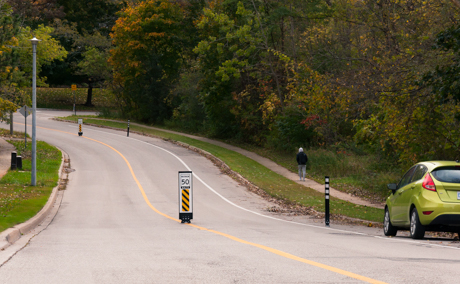
 A two‑lane road in a wooded residential area with several traffic-calming signs and posts placed along the centreline. A speed limit sign reading “50” is mounted on one of the centreline devices. A green car is parked on the right side of the road, and a person walks along the sidewalk in the background.

Speed reduction - Used in a series or in conjunction with physical traffic calming the signs are used to narrow the lane widths, altering driver behavior. The narrowed lanes make most drivers less comfortable speeding without negatively impacting emergency services and transit.

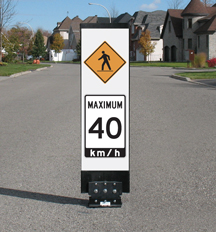
 A vertical traffic sign installed in the centre of a residential street. The sign displays a yellow pedestrian crossing symbol above a white speed limit sign reading “Maximum 40 km/h.” Houses, trees, and a clear sky appear in the background.

Pedestrian crossings - The seasonal traffic calming signs are also used to increase visibility and awareness of school or trail crossings. A sign placed near the centre of the crossing is more visible to the driver and increases awareness of the crossing.

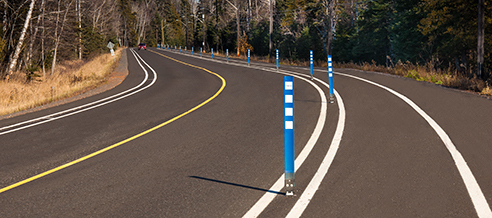
 A curved rural roadway lined with tall trees on both sides. A series of blue-and-white flexible lane delineator posts run along the inside edge of the curve, guiding drivers through the bend. A vehicle is visible in the distance.

Lane separation - The flexible bollards are commonly used to delineate bike lanes, multi-use trails or along the centre line of the road to delineate two-way traffic and prohibit passing.

Drivers, including cyclists, must stop and yield the whole roadway at: 

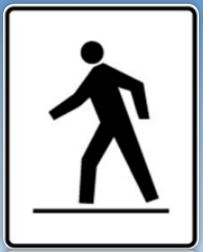
Pedestrian Crossovers

Pedestrian symbol of a walking figure on a white rectangular sign with a thin black border.

Where these rectangular black and white pedestrian signs are present pedestrians have the right of way, drivers are legally required to stop for the entire duration of the crossing

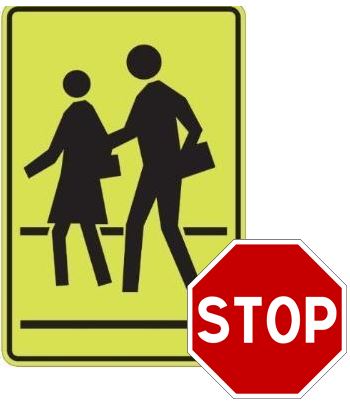
School Crossings With Guard

Yellow school crossing sign showing two walking figures holding bags, with a red stop sign graphic overlapping the bottom right corner.

Crossing guards control the whole crosswalk, drivers may not cross the crosswalk when the crossing guard has a stop sign on display even if their lane is open.  Pedestrians do not have the right-of-way unless a crossing guard is not present and displaying a stop sign.

Drivers and cyclists who do not yield may be fined $150 to $500 and face three demerit points. Crossovers are identified by specific signs, road markings and lights.


Types of Transportation

The benefits of living in a walkable community are endless. Walking is a great way to see parts of the City you normally wouldn't see by car. Cambridge has fantastic trails that are great for walking. Choose to walk to work or school and experience the advantages that walking brings. Check out the Trails page for more information. 

Avoid the traffic and hop on a bike for your commute. With over 280km of off-street trails and on-street bike routes, think of the places you can go! Discover the freedom and independence that cycling offers people of all ages. Check out the Cycling map to view the Cambridge Bikeway Network.

Grand River Transit (GRT) provides local bus service in the Region of Waterloo, including the city of Cambridge. Our main bus station is the Ainslie Street Transit Terminal at 35 Ainslie Street South in downtown Cambridge.

GO Transit offers bus service to the Greater Toronto Area. Go buses stop in the Cambridge SmartCentre on Hespeler Road near Highway 401. Go Bus Route 25 provides service from Kitchener to Mississauga.

  • What’s running today: ION Stage 1 LRT operates between Conestoga Station (Waterloo) and Fairway Station (Kitchener). 
  • Cambridge connection today: GRT Route 302 ION bus provides frequent service between Fairway Station and Ainslie Street Terminal (Cambridge).
  • What’s next: ION Stage 2 proposes extending LRT 17 km from Fairway to Downtown Cambridge (seven new stations). The Region is advancing the business case and design work. Follow updates on the Region’s Stage 2 page.

Neuron Mobility is the sole operator of a shared e-bike and e-scooter micromobility program in the Region of Waterloo. E-bikes and e-scooters are available to rent primarily in the downtown core of Cambridge.

Learn more about them at Neuron Mobility.

Download the Neuron Mobility app:

Learn more about this program:

Find rules for riding and how-to-ride information on ScootSafe. Choose Waterloo Region to get local information.

Where you can ride an e-scooter

Effective July 1, 2022, e-scooters are permitted within the City of Cambridge on:

  • All roads 50 km/hr or less
  • All roads with bike lanes, regardless of speed limit
  • On all boulevard multi-use paths
    • E.g., paved trails next to roads like Franklin Blvd or Fountain St.

Rules for riding

  • Helmets are mandatory for all e-scooter riders, regardless of age.
  • Sidewalk riding is not permitted.
  • E-scooters (motorized vehicles) are not permitted in parks or park trails.

Communauto provides carsharing services in the City of Cambridge.

Gain access to three vehicles and reserve at a low cost for a half-hour, an hour, a day or longer. There are three vehicles in downtown Cambridge at the following locations:

  • 1 at Beverly Street Parking Lot (15 Beverly Street)
  • 2 at Water Street Parking Lot South (9 Water St South)

For more information on rates, membership and FAQ's please visit ontario.communauto.com

Cycling Safety Tips

To give children a chance to develop the skills necessary for riding on the road, bicycles with a wheel diameter of 50cm or less can ride on the sidewalk (being courteous of pedestrian and aware of cars backing out of driveways) but must be walked through crosswalks.

From 30 minutes before sunset to 30 minutes after sunrise, you must have a front white light and a red rear light or reflector. You also need to be bright when it's dark due to rain, fog or snow.

By law, every cyclist under age 18 must wear an approved helmet. Riders under 16 years old: a parent or guardian must make sure their child wears a helmet.