This website uses cookies to enhance usability and provide you with a more personal experience. By using this website, you agree to our use of cookies as explained in our Access & Privacy page.
The City of Cambridge is responsible for maintaining trees on public property. Property owners are responsible for maintaining the trees on their private property.
Municipal tree services include:
Tree removal
Tree trimming
Tree planting (spring and fall)
Fertilizing
Disease diagnosis
Pest diagnosis
After hours emergency service, such as tree damage during a wind storm
Contact the Forestry Call Centre for information about municipal trees or municipal tree services. If you are calling after hours for emergency tree services, please call (519) 623-1340.
Removing a Tree
For a step-by-step guide on the Private Tree Removal Application process, please watch the following video:
Private Tree Permit
As outlined in the Private Tree By-Law (23-105), a permit is required to remove, cut down or in any other way injure a tree with a diameter of 20cm (8 inches) or more on private property. The tree diameter measurement must be taken at 1.4m (4.5 feet or approximately at chest height) above ground level. It applies to the removal of 1 - 9 trees on all land use types including single family residential properties.
For the removal of 10+ trees (greater than 20cm) a Site Alteration Permit is required. An application for a Site Alteration Permit, along with supporting information can be submitted to engineering@cambridge.ca .
Private Tree Exemptions
Below outlines the 4 private tree exemptions and details of the submission requirements for each:
1. The private tree to be removed is dead:
Request for removal submitted to forestry@cambridge.ca prior to the removal of the tree including a photo of the dead tree, description of location(s), species, and DBH (cm) of the tree.
2. The private tree is injured for the purposes of maintenance pruning as determined by a qualified tree professional:
“Maintenance pruning” means the pruning or removal of tree branches in accordance with good arboricultural practices, as specified by the International Society of Arboriculture.
3. The private tree is an imminent hazard to any person, building, structure, utility service, or vehicle.
"Imminent hazard" means a tree which is destabilized or structurally compromised to an extent that an immediate danger of death, injury or structural damage exists, including, but not limited to hazards or damage to infrastructure that cannot be addressed without adversely affecting the health of the tree.
Failure of the tree or tree part(s) has started or is most likely to occur even if there is no significant wind or increased load.
Significant changes to the structure or stability of the tree (i.e. uprooting, splitting, cracking, etc.). Tree risk cannot be eliminated or significantly reduced through other means such as pruning or exclusion.
Imminent hazard exemption requests can be submitted to forestry@cambridge.ca prior to the removal of the tree. Imminent hazard exemption requests must include:
Detailed Arborist report documenting and detailing the imminent hazard, clear photos of the imminent hazard, description of location, species, and DBH (cm) of the tree.
If the imminent hazard submission does not clearly confirm the imminent hazard, the exemption may be denied (see #4 below).
Tree Risk Assessments (TRAQ) are preferred (but not required) and may expedite the review.
Denial of an imminent hazard exemption does not prohibit the removal of the tree. It simply means that the removal must proceed through the standard permit application process, including any applicable compensation requirements.
4. If a tree or tree part presents an emergency (i.e. storm damage, tree failure), removal or mitigation may proceed prior to the issuance of an exemption. However, documentation shall be provided to forestry@cambridge.ca with 48 hours of the injury or removal of the private tree and may be subject to compensation if the submission does not clearly show the emergency situation.
Do not apply if the tree is dead or poses an imminent hazard; it may be exempt. See exemption details above.
Permit fees are non-refundable.
Submitting an application does not guarantee approval.
Required Documents:
Arborist Assessment by a Qualified Tree Professional, including tree location, species, DBH (cm), and condition.
Permit Fee $64.98 ($57.50 + HST), payable before submission.
Clear Photos of the entire tree(s).
Adjacent Property Owner Consent Form (if applicable), for trees near property boundaries.
Process:
Submit your complete application online.
Pay the application fee.
Identify compensation method: either qualifying replacement tree plantings, cash-in-lieu of replanting or a combination of both methods.
Staff will review the application.
If appliable, cash-in-lieu payments are made prior to permit issuance.
Permit will be issued.
You may not proceed with the injury or removal of the tree(s) until you have received the permit. More information can be found by viewing the Cambridge Private Tree By-Law (23-105), if bylaw is required please contact Service Cambridge at 519-623-1340.
Note: Payment must be in the form of a certified check, bank draft, debit or credit card (MasterCard or Visa) and can be paid at the Service Cambridge counter at City Hall. Online payments only accept Visa or Master Card up to a $10,000 limit.
The City’s Tree By-law 71-06 is applicable City-wide, and regulates the planting, propagation, preservation and removal of trees on lands owned by the municipality or over adjacent to highways under the jurisdiction of the municipality.
The Private tree By-law 23-105 is also applicable City-wide and regulates the destruction or injuring of trees on private property measuring 20cm at diameter at breast height or greater.
This is the standard for measuring trees and refers to the tree diameter, outside the bark, at breast height, approximately 1.37 meters from the existing grade of the ground adjoining the base of the trunk.
The application fee for a Private Tree Removal is $64.98 ($57.50 + HST) and is non-refundable. Additional fees may apply if you choose to pay cash-in-lieu over planting a replacement tree. The current rate for a replacement tree is $607 + HST if you are applying through the Private Tree Removal Permit, and $784.13 + HST with any development application, including the Site Alteration Permit.
Replacement trees are required for the removal of any trees on private property measuring 20cm at Diameter at Breast Height (DBH) and greater. The number of replacement trees is based on the size of the tree being removed (see chart below). If you chose not to plant a replacement tree on your property, a cash-in-lieu payment of $607 (2026) + HST per replacement tree is required.
Replacement Tree Calculations
DBH (cm) of Tree Removed
Number of Replacement Trees* Required
Cash-in-lieu Required
<20cm
0
$0
20-30cm
1
$607
31-40cm
2
$1,214 (2 x $607)
41-70cm
3
$1,821 (3 x $607)
>70cm
4
$2,428 (4 x $607)
*Replacement tree must be of a 7-gallon or greater pot size and 20 millimeters or greater in diameter.
Cash-in-lieu payments are directed to the City’s Replacement Tree Planting Reserve Fund. This fund is managed by the City for the purpose of planting trees on public property within the City of Cambridge.
Replacement trees must be of a 7-gallon or greater pot size and 20 millimeters or greater in diameter. Invasive species and ‘dwarf’ varieties are not permitted. Suggested species include but are not limited to the following:
Sugar maple (Acer saccharum)-large
Red maple (Acer rubrum)- large
Black maple (Acer nigrum)- large
Tuliptree (Liriodendron tulipifera)- large
Eastern white pine (Pinus strobus)- large
Turkish hazel (Corylus colurna)- medium
Canadian serviceberry (Amelanchier canadensis)- medium
Generally, tree roots are not capable of penetrating solid surfaces such as house foundations or underground utility pipes. In most cases, when tree roots encounter an impervious surface, such as underground pipes or a house foundation, root growth is redirected laterally along the hard surface, or around the pipe. However, tree roots are opportunistic and can exploit existing breaches or cracks and can cause additional damage in search of additional moisture.
If you suspect that a City owned tree may be damaging your foundation or public or private underground utilities, please contact Service Cambridge (519-623-1340) and our Forestry Technicians will investigate the concern.
Tree Maintenance
Our Forestry department manages the maintenance of City-owned trees, including trimming, removal and fertilizing.
Removing or trimming of City-owned trees is a violation of City Tree By-law. Homeowners must confirm ownership of a tree on or near their property before doing any work on it, such as trimming.
We appreciate your help with watering newly planted trees, as well as any tree during long periods of drought. For all other maintenance issues of City-owned trees, contact the Forestry Call Centre.
If you are calling after hours for emergency tree services, please call (519) 623-1340.
Every spring our Forestry Call Centre receives thousands of work requests. It can take our staff months to complete the large number of requests we receive.
An ice storm or a windstorm can prevent us from getting to your tree right away, as safety hazards and dangerous trees take priority and move to the top of our work list.
Both City employees and contractors are responsible for thoroughly cleaning up after themselves. Please note that larger wood may be left on your property until appropriate equipment is available to remove it.
If the tree is between the sidewalk and the curb, it's a City-owned tree. If there isn't a sidewalk or the tree is located on your front yard, contact the Forestry Call Centre to have a tree technician come out to measure property lines and determine if the tree is privately owned or City-owned.
No, you shouldn't prune trees for the first year or two after planting it. City contractors do everything required for the tree at the time of planting.
When we refer to the size of a tree, we usually use the girth of the tree's trunk. We measure the girth of a tree trunk by a standard arboricultural method called "diameter at breast height" or "DBH."
The City relies on residents to help with the care of new, young trees. We deliver a tree care pamphlet to your door on the day we plant the tree.
Water it thoroughly once a week in dry weather. Please use caution when using grass trimmers near the tree. The City appreciates your help with caring for the new trees, however, please do not trim or prune the trees.
Sometimes there just isn't enough space to plant a new tree, even if there was a big tree there before. Decades ago, trees were often planted in very narrow boulevards but when the trees got bigger they would damage the sidewalk, curb or road. We try to avoid these problems now by not planting a tree unless there is enough space for it to grow to its mature size.
We plant trees in the spring and fall. This is the best time of year to transplant trees. Some species of trees can only be planted in spring and others only in fall. If you are in a new subdivision, the street trees will be planted once all roadside landscaping is complete, including sod.
In general, we plant trees that are two to three metres tall, with a trunk about four to five centimetres thick. We stake the new tree with two wooden stakes and biodegradable twine to brace it for the first year.
When you request a tree to be planted, our arborist will recommend an appropriate species for the location.
The location of a new tree depends on a few things, including:
Mature tree size
Soil volume
Buildings and hydro lines in the area
If the new tree is replacing a small tree, it will likely go in the same location as the previous tree. If the new tree is replacing a very large tree, the new tree can't go in the exact same spot, because roots from the former tree impede growth for the new tree.
Cambridge's Tree Dedication Program is a way to remember a loved one, celebrate a birth, honour a retiree or commemorate any other event. The program plants trees in approved areas within City parks and cemeteries.
When you apply to dedicate a tree through our program, the Manager of Horticulture and Forestry Services will:
Work with you to select a suitable tree for the area.
Approve the site for planting and suggest alternative sites, if required.
Purchase the tree and determine if it's healthy upon its arrival.
Have the Forestry department properly maintain the tree once it's planted. Trees and plaques are guaranteed for a ten (10) year period.
All costs for participating in the program must be made payable to the City of Cambridge Community Services department before the planting date.
If you request a memorial plaque for your tree dedication, it must be ordered six weeks before the planting date. We can also install it at a later date, if needed. Costs for a memorial plaque vary and you must include the receipt for your payment with your order.
Are you thinking about planting a tree on your private property? The City of Cambridge, in collaboration with Reep Green Solutions, offers a Backyard Tree Planting Program to Cambridge residents.
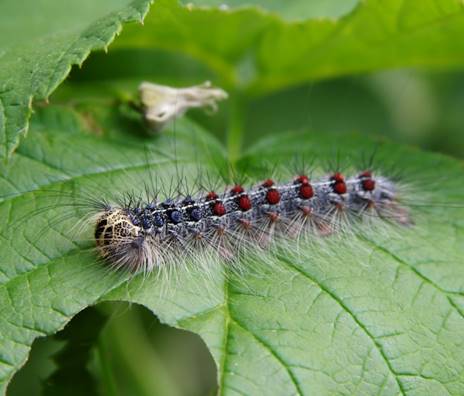
Spongy moth or Lymantria dispar dispar, formerly known as ‘gypsy moth', is an invasive insect first detected in Ontario in 1969. Spongy moth caterpillars feed on tree leaves and are present across southern Ontario, including in Cambridge.
Figure 1: spongy moth caterpillar stage
When populations are high, they can defoliate whole trees and forests in a short amount of time. Spongy moths prefer oak trees, but will feed on a variety of hardwood tree species.
Typically, its population peaks every seven to ten years, and will reduce through natural causes. Under normal circumstances, defoliation caused by these insects won’t kill a tree. However, trees can decline to the point of death in some cases when defoliation is coupled with dry hot summers or impacted by other forest pests.
What you can do at home
Monitor your hardwood trees (like oaks, maples, beech and walnut), for the presence of larvae.
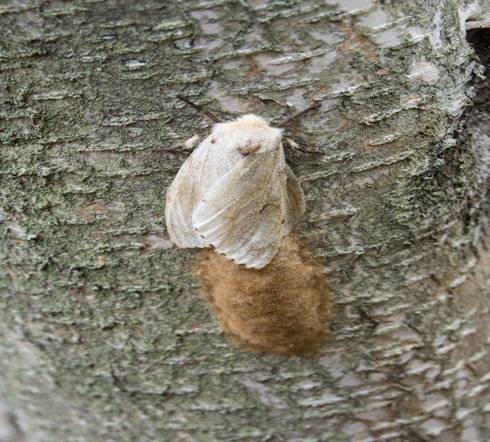
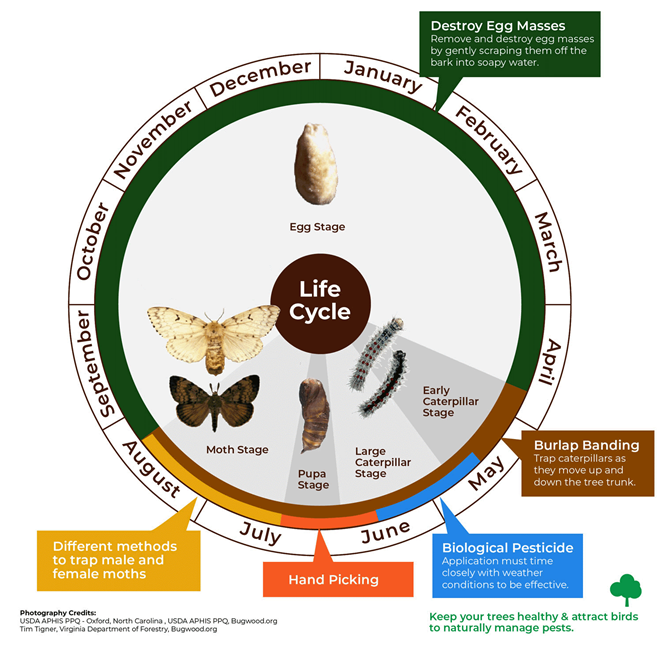
Spongy moth spend the winter in egg masses. Egg masses can be found on a variety of surfaces including trees, rocks, houses, boats, trailers, fences, picnic tables, and firewood.
Figure 2: Female spongy moth with egg mass
The eggs hatch in spring (April to mid-May) and young caterpillars begin feeding by cutting small holes in the surface of leaves. You can identify them by the five pairs of blue and six pairs of red spots along their backs. Feeding is normally completed by early to mid-July.
Help manage spongy moth by following these techniques:
April to August - Burlap Banding
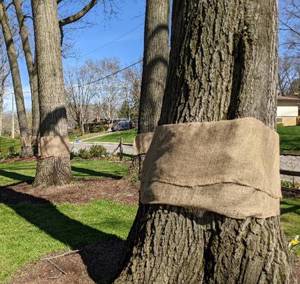
Once Spongy Moth caterpillars grow to about an inch (2.5 cm) in length by mid-June, they will move down the trunk to seek shelter from predators and heat. Reduce the number of larvae on the trees in your yard by trapping them.
Figure 3: Burlap banded trees
Step-by-Step Instructions
Wrap and secure a piece of burlap cloth around the stem/trunk of your tree.
Tie twine or rope around the center or slightly below the center of the burlap.
Drape the burlap cloth over the twine or rope so there is an overhang where the caterpillars can crawl underneath to seek shelter during the day.
Check the trap by lifting the overhanging burlap cloth every afternoon and collect any hiding caterpillars.
Put them into a bucket of soapy water for 2-3 days to destroy them.
Late May to Early June - BTK Application
You can apply a product that contains BTK (Bacillus Thuringiensis “kurstaki”) to foliage at the early stage of caterpillar development when caterpillars just begin feeding. This is usually around mid-May. The pesticide must be ingested by the caterpillar to be effective.
For small trees and shrubs that you can reach, products like Safer® Brand Caterpillar Killer can be purchased at local garden supply stores.
June to July - Hand Pick Caterpillars
Handpicking caterpillars is still one of the most effective ways to help control Spongy Moth on small newly planted trees, shrubs, and plants. If possible, you can also gently shake the tree, so caterpillars fall from the leaves. Thoroughly inspect the remaining foliage, branches, and trunk for caterpillars, and using gloves, pick them off your tree. Fallen and collected caterpillars should be placed and left to soak in soapy water.
What to look for - The caterpillars of Spongy Moth are dark and hairy. They have five blue dot pairs and six red dot pairs on their back. They go through 4-5 "molting" events where they shed their skin and each time, they get bigger.
July to August - Spongy Moth Trap
Step-by-Step Instructions
You can purchase the traps at various retail stores or online throughout your area
Put the traps out when the moths are active after coming out of their pupa stage of growth. Only male moths are attracted to the traps.
Homemade traps can be created with various designs found on websites. The traps have a bait inside their lid that smells like female Spongy Moth pheromone for attracting males.
Once captured, put the moths in a container of soapy water and leave them for 2-3 days, then dispose of the contents.
August to April - Egg Mass Removal
Survey your property for egg masses and scrape them off surfaces into soapy water to destroy them.
Step-by-Step Instructions
Place your catchment container below the egg mass
Use your scraper tool to remove the egg mass from the surface. Ensure that all eggs are scraped. Try not to leave any residual eggs in bark ridges or crevices.
Empty the contents of your catchment container or bag into a bucket of soapy water
Leave the eggs sitting in the bucket for 2-3 days, then dispose of the contents.
Egg masses can be located high up in trees. Care needs to be taken if trying to access anything aloft, especially if using ladders. Some private tree care companies can be hired to provide this service at heights.
The EAB is a species of beetle, which attacks and kills ash trees. Originally found in Asia, the EAB has killed millions of trees in North America.
Where are EAB infestations found in Cambridge?
This pest was originally detected in two woodlands on either side of Highway 401 at Homer Watson Boulevard within the cities of Cambridge and Kitchener. It is thought that this forest pest arrived at this location along the highway several years ago and since that time has become well established throughout Cambridge.
How will Cambridge solve the EAB issue?
Out of about 55,000 street trees in the City of Cambridge, more than 4,000 are infested with EAB. Certified arborists inspect our ash trees and assign a rating based on several factors, including:
Infestation level
Structural condition
Using this rating system, we schedule tree removals in a priority sequence, beginning with the highest priority trees.
When will infected trees be removed?
The City of Cambridge Forestry department will continue to remove infested ash trees as needed.
Urban Forestry is the careful care and management of tree populations in urban settings. Forestry helps improve the environment and raises awareness about how important trees are to the City of Cambridge's infrastructure. Urban foresters plant and maintain trees, support appropriate tree and forest preservation, conduct research and promote the many benefits trees provide.
The City of Cambridge has anUrban Forest Plan (2015 to 2034) and the Emerald Ash Borer Action Plan, both approved byCouncil on June 16, 2015.
Developers are required to submit a Tree Management Plan and Arborist Report and follow the Tree Management Policies and Guidelines outlined is Sections 2.19 and 7.14 of the City's Engineering Standards and Development Manual, email engineering@cambridge.ca to request a copy.
The Arborist Report and Tree Management Plan (TMP) will inventory trees, assess their condition, note tree removals and required tree replacement compensation, and identify trees to be retained through the grading and construction process and their protection measures.
City Forestry Services reviews TMPs and applicants should pay special attention to street trees that are regulated by the City's Tree By-law (City's Tree By-law 71-06, includes amendment By-law 21-068), trees that straddle property lines or are on the applicant's property but close to boundaries, and trees on neighbouring properties and whether they will be impacted by grading/construction, and proposed measures to protect them if they will likely be impacted. Applicants are encouraged to complete a TMP as early as possible to inform site design or the Zoning By-law public meeting and process, or as a required condition on a grading permit or development application.
In December 2013, Council received the Cambridge Urban Forest Canopy Assessment Report, Assessment Maps Part 1 and Assessment Maps Part 2, which show:
Cambridge has an overall canopy of 27 per cent tree coverage.
Various neighbourhoods range in tree coverage from 5 to 47 percent.
A further 25 per cent increase in tree coverage is possible through tree planting initiatives.
The report also demonstrated that trees provide us with many valuable ecosystem services, including:
Energy conservation
Stormwater management
Air pollution removal
View the Canopy Assessment area mapping to see current canopy coverage, potential areas for planting and ecosystem services for 38 neighbourhoods and every lot in the City of Cambridge.
Urban Forestry is also important to the City of Cambridge because mature tress provide shade, which helps protect our health. Skin cancer is the most common cancer in Canada. Shade can reduce ultraviolet exposure by as much as 75 per cent and has been shown to be an effective strategy to reduce skin cancer. With increasing skin cancer rates and summer high temperatures combined with paved surfaces, the shade provided by trees (or other shade structures) is more important than ever.
The City of Cambridge Official Plan contains policies for providing shade in both private and public spaces. The City is committed to providing shade wherever possible, such as in our parks. We'll increase shaded areas in the City in partnership with:
To encourage tree planting in the city, we’re giving away free trees to Cambridge residents on Saturday, April 25th at the Riverside Soccer Field parking lot from 8 a.m. to 12 p.m or until Sold Out.
Three native tree species are available to choose from, while supplies last. Each are approximately one metre tall.
Plant a tree on your property to improve air quality, fight climate change and increase property value.
Rules and eligibility
Must be a resident of the City of Cambridge
One (1) tree per address and per person, while supplies last. No registration required, but proof of a Cambridge address must be presented on site to qualify for a free tree.
Tree must be planted on private property (we suggest side or backyard)
Residents are responsible for planting, watering, and maintaining the tree
If you are a Cambridge resident and would like a free tree, you can pick it up:
Date: Saturday, April 25, 2026 Location: Riverside Soccer Field parking lot, off Rogers Dr just west of the Speedsville Rd entrance. Time: 8 a.m. to 12 p.m. (Rain or shine). This is a drive-thru pick up.
Note: Please bring proof or your name and address to verify your tree selection at pick up.